As the season enters its final month, predicting baseball's playoff teams is a tricky exercise. Following the pennant races requires daily scoreboard watching and magic number recalculation. This is especially true in the National League, where every club except Washington, Chicago and Pittsburgh is within five games of the Wild Card spot.
Amid constant realignment of standings, flurries of last-second waiver deals and potentially devastating injuries, there is still so much baseball left that the process of forecasting October matchups may seem a trifling matter, although knowing this doesn't stop us from staying up late at night, wondering if Josh Rabe will get postseason at bats against lefties, and how Jeff Weaver might figure into the Cards' playoff rotation, for example.
No less daunting a challenge, and thus all the more ripe for debate, is the task of identifying the player in each league who is deserving of the MVP award.
Ah, the Most Valuable Player. Just typing the words brings frustration. The award's winner must perform at a level of superlative excellence, yet the methods for identifying excellent performance are superlatively undefined. Must he come from a playoff team? Has he driven in lots of runs? Produced without lineup protection? Does he dazzle in the field? Can he raise his game against rival teams? How clutch is he? To get to the heart of the MVP debate, we must decide what qualities are important in a candidate, and then we can attempt to quantify these qualifications.
Of course, this is easier said than done.
Consider the phrase in whole: Most Valuable Player. Not a single word of the three clarifies our expectation of who should be among those discussed as candidates. After all, what constitutes a "player?" Does this designation apply only to fielders who "play," or do "players" designated as hitters fit the bill? What about pitchers? Are they not "players?" Before we can differentiate among different types of "value," gauge their varying capacities to be measured, and extrapolate a ranking of these metrics, arguments for who is eligible as a "player" stand to complicate the discussion.
Just as the Wild Card has impacted the dynamics of September (and October) baseball, discourse on the MVP award has shifted accordingly. Over the coming days and weeks, I will study the threads of logic and preference that have produced the MVP finalists of the last dozen seasons. By focusing on the top end of each ballot, I hope to determine what qualities are favored in the selection of certain candidates over others as most valuable. My findings will be based on data available at Baseball-Reference.com and Retrosheet.org, and other sources, as noted.
(Note: While it may be difficult, I will try to avoid treating the voting bloc of the Baseball Writers' Association of America (BBWAA) as a monolithic entity, and parse the behavior of its members into distinct categories as best I can -- with the data available. Any reader who is able to provide me with links or information about confirmed, actual complete MVP ballots as submitted by BBWAA members would be extremely helpful, as my own research efforts to collect such data have produced few successes.)
Tuesday, August 29, 2006


Thursday, May 11, 2006
Early Surprises in a Seesaw Season
Bad luck and good luck (usually) battle to put a stamp on a season’s worth of box scores. For instance, pointing to the Washington Nationals’ outstanding record in one-run games was a popular explanation for the team’s early dominance last season. Sure enough, the Nats’ luck evened out as their fluky run of close victories sharply reversed course on July 7. Come playoff-time,
The idea that the law of averages will catch up with a streaking ball club looms large when attempting to evaluate a team’s record just 35 games in. However, while it is often said that a win is a win – each game counts just as much in the standings, no matter when it is played – translating that idea to the realm of individual performance does not always compute. Fact is, nobody wants to get off to a rough start, whether a team or a player, but this is particularly true of career role players, and of players who have not yet cashed in on free agency. Just as the Nationals’ streakiness was the somewhat inevitable consequence of playing a 162 game-season, every hitter will experience ups and downs, but the timing of a hot start, combined with other factors, goes a long way toward alleviating concerns that a player may never make it in the show.
I’m not suggesting we overlook the frustrations and pressure that exist for struggling veterans, too. There is nothing fun about watching former All-Stars Edgardo Alfonzo and Bernie Williams play their way to the bench, and far be it from me to question their desire as competitors. It’s consoling to know, however, that these guys can look back and remember when, rather than wondering what if. Players of their stature can fall back on a pile of money to cushion the blow of a disappointing start. Does anybody honestly think Adrian Beltré has felt that much pressure since he got paid by
I have identified some players whose early-season successes typify the excitement and confusion inherent in trying to understand five weeks’ worth of data, let alone prognosticating the unforeseen. My choice of subjects is arbitrary and incomplete – I might well have discussed Alexis Rios, Xavier Nady or Austin Kearns, to name a few. Nobody I know predicted this level of supremacy for these (mostly) unproven hitters; this is what they have in common. Each is on his way to having a fine season, and each needed to have this type of success for the sake of establishing himself as a player of true major-league caliber.
Perhaps because he appeared (and appears) the least likely of the group to betray all previous levels of performance, perhaps because his name is alliterative, I have written mostly about the Indians’ Ben Broussard. To the extent that it is possible, let’s try to get a more accurate read on his batting numbers compiled as of May 9, and see what jumps out.
Ben Broussard: First Base, Cleveland Indians; Age 29 - 465 Career games
Early returns: .395 batting average; 5 homeruns; 22 runs batted in
Projected 2006 totals: .395-25-111
Previous career highs (minimum 100 ABs): .275 avg. (’04); 19 HR (’05); 82 RBI (’04)
Big Ben has settled nicely into his role as the No. 6 hitter in Eric Wedge’s lineup after a 2005 season in which he oscillated from the three-hole to the seven-spot. The left-handed member of
Anyway, Broussard broke through in a big way during a three-game series against the Red Sox, when he was 7-for-9 with three taters and 10 ribbies, including 8 RBI on April 27. The
It may be naïve to suggest that Broussard, or any major leaguer, is motivated by such things, and I am wary of putting too much stock in Broussard’s quick start, partially because his history as a streaky performer is difficult to ignore. The role of luck is obvious when considering Broussard’s home/road splits: through Monday’s games, his numbers at Jacobs Field are staggering (.513 avg., .548 obp., .974 slg.), but on the road he has performed like a slightly better version of Marlon Byrd (.298/.340/.365). He isn’t usually asked to face lefties, against whom he is hitting a paltry .125 with six punchouts in 16 tries, compared to 32-for-70 (.457) with 22 RBI against right-handers.
There’s not much here to suggest that 2006 might be the Year of Ben Broussard any more than it might be the Year of Ron Belliard, or it might be the Year of Eduardo Pérez. My point, of course, it that if we assume he stays in the sixth spot of the order, a full season of Broussard at his peak realistically could net the Indians something like 25 homeruns and 111 RBI, and wouldn’t that be wonderful? Sure, there will be regression in Broussard’s batting average, which is currently 129 points better than his career line and may fall below .300 by month’s end. On the other hand, it’s not as though much of anything was expected out of him, beyond a slight improvement over his 2005 OPS of .770, which ranked 11th out of 15
Other April/May Surprises:
(Stats are through games Wednesday, May 11, 2006)
Casey Blake: Left Field, Cleveland Indians; Age 32 - 533 Career games
Early Returns: .368-4-24
Projected 2006 totals: .368-19-111
Previous career highs: .271 avg., 28 HR, 88 RBI (all in ’04)
Admittedly, it might be a bit of a stretch to think of Blake as an unproven player; given his age and résumé – he is a three-time draft pick, a three-time waiver claimee, a two-time Minnesota Twin with a .779 lifetime OPS – nobody could be blamed for holding fast to her conception of Blake as nothing more than a career fourth-outfielder who happens to play for a contender in the American League Central. In case you’re wondering: No, I don’t mind if it’s obvious that I’m making excuses for my antipathy toward mighty Casey and his unseemly .368 batting average, which is second-highest in the bigs and OBVIOUSLY can’t last.
There is a silver lining in my cloud of pessimism, which is that you can say what you will about homeruns being commonplace and having too much impact on slowing the modern game, but dingers are still the best measurable outcome of an at bat we can think of, and the records show that Casey Blake has hit more of them (72) since 2003 than any Cleveland hitter not named Pronk. His ability to do this, and stay healthy (he has missed just 37 in that span) make him about as bankable a player as can be found. There’s just not much available for withdrawal.
Joe Crede: Third Base, Chicago White Sox; Age 28 - 536 Career games
Early returns: .319-7-25
Projected 2006 totals: .319-34-123
Previous career highs: .285 avg. (’02); 22 HR (’05); 75 RBI (’03)
Okay, so maybe Crede wasn’t exactly fighting for a roster spot. It would have taken a lot for or Pablo OzunaAlex Cintron to supplant one of Chicago’s postseason heroes, but with the young Josh Fields doing quite nicely in his first tour of the International League, Crede’s huge strides at the plate so far have likely spared GM Kenny Williams the potentially difficult decision of cutting bait on a homegrown talent who has yet to pan out as expected. Super Joe has been great in the clutch, batting .379 (11-for-27) with 17 RBI in ABs with runners in scoring position, and really turning up the heat when there are two outs (.378-4-11).
It so happens that Crede has a shot at becoming the first Sox third baseman with three straight 20-HR seasons, which is nice, but there’s a reason such tidbits are referred to as “trivia.” If Jermaine Dye’s history of injuries continues to be a problem, the need for Crede to out-perform his career line of .259/.308/.447 will become much more pressing.
Nick Johnson: First Base, Washington Nationals; Age 27 - 486 Career games
Early Returns: .320-9-22
Projected 2006 totals: .320-43-105
Previous career highs: .289 avg. (’05); 15 HR (’02 & ’05); 74 RBI (’05)
Johnson finally seems to be shaping into the more rounded (not in the pre-2002 Jason Giambi sense) hitter the Expos were hoping for when they sent Javier Vazquez to the
Prior to this season, I pegged Johnson as a likely candidate to find another gear to his offense, in part because of the mustache, but mostly because he 2006 is Johnson’s Magical Age 27 Season. He always knew how to get on base (266 walks in 486 games), a skill which has led to 21 non-intentional walks, twelfth-most in the ML. So far, Johnson has delivered on that promise, failing to reach safely in only four games he’s started. Alfonso Soriano and Ryan Zimmerman can handle the bat, and Josés Vidro and Guillen are on board as high-end filler. Johnson is the heart of the order, and is a good bet to reach one, if not two of those triple crown projections listed above. Remaining entirely healthy may be a struggle, but if he is, Johnson will remain consistent enough at the dish to challenge Lee Stevens for 30th place in RBI on the all-time franchise leaderboard. And he’s got a better mustache.
Ty Wigginton: Second / Third Base, Tampa Bay Devil Rays; Age 28 - 436 Career game
Early Returns: .256-9-30
Projected 2006 totals: .256-44-145
Previous career highs: .302 avg. (’02); 17 HR (’04); 71 RBI (’03)
Wigginton is he most genuinely surprising power source to emerge this season. After the Pirates released him this past off-season, it seemed the one-time Mets third baseman of the present was on the fast track to irrelevance (or
In the three weeks since, a 13-for-62 (.201) slide has damaged those averages; even worse, Ty has managed just three extra-base hits since his power surge, and may find playing time tough to come by as Aubrey Huff and (eventually) Jorge Cantu return from injury. Depth at third base happens to be one of the Rays’ strengths in 2006, and Wigginton’s stay with
Wigginton is a perfect example of how baseball’s long season is a gift that keeps on giving. Sure, come September, his hot start will long be forgotten, but by then, dozens of others will have picked up the torch to light the baseball world on fire for two, three, maybe four weeks at a time. It’s unlikely that all the players mentioned in this space will pan out in 2006, but a few of them will enjoy breakout seasons, and maybe even earn a first All-Star selection. Wouldn’t it be great to see Chris Shelton, the ultimate hot-to-cold April story, return to
Wednesday, May 3, 2006
TEAM REPORTS: Diamondbacks
LOOKING BACK: At 14-13, Bob Melvin’s team is right in the thick of the NL West standings.
THUMBS UP: The strikeouts are troubling – his 27 Ks are the sixth-most among non-rookies in the NL – but Chad Tracy is providing a nice encore to his breakout 2005 season, when he finished among the top 10 in the league in batting average (.308) and slugging percentage (.553). His ability to play third base enabled GM Josh Byrnes to pull the trigger on the Troy Glaus deal (more on that later), and the versatile
THUMBS DOWN: The biggest of the Diamondbacks’ off-season trades brought a much-heralded defensive second baseman and a lifelong pitching project to the desert. Neither has lit the world on fire so far in 2006. Orlando Hudson has driven in four runs through his first 99 at bats, and Miguel Batista sports a nifty 7.65 ERA and 2.2 WHIP since his first start. It hasn’t helped that Troy Glaus is tearing it up for the Blue Jays, batting .265/.365/.602, or that his 24 runs, 22 RBIs and 16 walks place him among the top three AL third basemen.
LOOKING AHEAD: Though the Glaus/Hudson/Batista deal may appear lopsided on May 3, this was a solid trade for both teams, and come September 3, it may be much easier for D’backs fans to stomach. Nothing about the Snakes screams “Division Champs,” but the same can be said about every one of their rivals in the NL Worst. The arrival of Stephen Drew will be a reason to follow this team through the rest of the first half, assuming Craig Counsell doesn't become the .340 hitter he's been in video games for years.
Tuesday, May 2, 2006
TEAM REPORTS: Braves

Atlanta Braves
LOOKING BACK: After the worst April since Bobby Cox re-joined the Braves as manager in 1990 (see graphic), there is nowhere to go but up for a franchise that finds itself in an unfamiliar place: second. The Braves suffered injuries to the left side of the infield and, to their credit, the fill-ins have performed serviceably. Okay, so the Braves only managed just over 3.8 runs per contest in Larry’s absence, but we didn’t really expect that much production from Wilson Betemit and Pete Orr (.229 average, 3.9 K/BB ratio through May 1), did we? If these past few weeks are a preview of what the future (as in 2008) holds for
THUMBS UP: The good news, such as it is, would have to be Edgar Renteria’s blistering start, which, while it hasn’t led to success in the win column, is definitely an encouraging sign. After the Mummy’s downright awful 2005 campaign in
(Digression: As Tom Glavine and Greg Maddux enjoy brilliance in their grey years, it has been difficult not to notice that
THUMBS DOWN: Oscar Villareal (4-0) is the team’s win leader, as the starters have pitched poorly, or received little run support. Forecasting a decline for Jorge “I Miss Leo Mazzone” Sosa wasn’t too difficult, as the former Devil Ray rotation castoff (never a good suffix) was due to suffer a bit once his luck started evening out.
I hesitate to place all the blame on new pitching coach Roger McDowell. By all accounts, he is a fine teacher and will have his work cut out for him, with youngsters Joey Devine, Blaine Boyer, Macay McBride and Chuck James ready to make an impact with the big club. McDowell’s predecessor looms large in the equation, however, and Mazzone’s strength always seemed to be reclamation projects like Sosa and Thomson, with Wright, John Burkett, and Chris Hammond before them. I have little doubt that McDowell will bring along the young pitchers just fine, but the Braves as a team cannot win games unless the No. 3-5 starters consistently deliver 6-7 strong innings. This will bear watching throughout the season, and into next year, when Hampton will begin to rebuild himself and the young Braves are a little more seasoned.
LOOKING AHEAD: Starting tomorrow, the Braves will play 15 straight games against NL East opponents, including this weekend’s series against the Mets that will be
Monday, May 1, 2006
TEAM REPORTS: Angels
LA Angels of
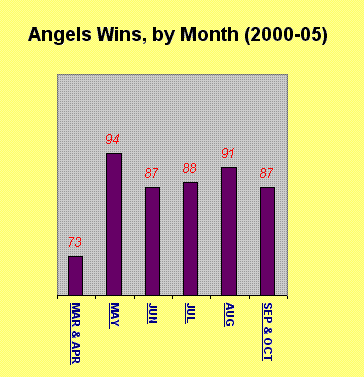
LOOKING BACK: The competition’s struggles have allowed Los Angeles’ AL team to remain near the top of the standings in the West, which is a fairly positive remark as Mike Scioscia’s ball club wraps up a rather ho-hum month. Although April was only the third time the Angels have recorded a losing month since their recent playoff run began in 2004, fans of the Halos may find comfort in the knowledge that April has consistently been the team’s weakest overall month since Scioscia took over as skipper before the 2000 season (see graphic).
THUMBS UP: Vlad Guerrero continued to do his thing (.306-6-20), and the starting trio of John Lackey, Kelvim Escobar and Ervin Santana has succeeded (8-3, 3.42 ERA), making the absence of reigning Cy Young-winner Bartolo Colón a bit easier to stomach. Going into the last day of the month, Angels relievers had posted a 2.61ERA, best in the American League. Carrying the load, as usual, are the spectacular Scot Shields (13.2 IP, 0.66 ERA), Brendan Donnelly (12 IP, 2.25 ERA) and Frankie Rodriguez (8-9 in saves, 15 Ks/10.2 IP).
The three-headed monster of Shonneliguez has combined to make late-inning domination the pitching staff’s greatest strength, followed closely by its collective weight – Esteban Yan (255), Colón (250) and Donnelly (240) are easy choices for “Angels Players Who Should Never Be Seated In The Same Row On The Team Airplane.” (It’s a good thing
THUMBS DOWN: No team has drawn fewer walks than the Halos’ 47, a major reason the team’s on base percentage stands at .302, second-worst in MLB. The Angels have scored just 112 runs so far, a weaker total than every
I am pessimistic about how long the Angels can hang around the top of the division if this level of offense remains the norm, and it is difficult to forecast a brighter scenario among this collection of “talent”. Perhaps Orlando Cabrera (.302-4-19) and Adam Kennedy (.324/.363/.459) will continue their early success, and Darin Erstad (.238/.279/.350) will turn back the clock to the year 2000. More likely, one or both of the Angels’ middle infielders will stop playing above his head, and Erstad will play out the season as a ghost of his former overrated self.
THE ROAD AHEAD: The Angels play only 8 games within their division in May, including two against
Subscribe to:
Posts (Atom)

 Posts
Posts

